
Point Frederick – Spinnaker – May 18, 2026
A pre-mortem analysis to consider a disconfirming scenario of higher, more volatile rates.

Lately, we’ve been pounding the table on technology. Earnings have been spectacular, even as the realization of the dramatic changes AI is creating is becoming more widespread.
This week, though, the principal threat to the thesis reared its ugly head: higher interest rates.
Markets have selective focus. They are interested in one thing, then they switch their focus to something else. In Keynes’ beauty pageant analogy, we might say that skinny is in one day and overweight the next, only to see skinny or “traditionally attractive” come back into vogue.
Confirmation bias refers to the behavioral distortion in which individuals seek out (or see) only information that aligns with their view of the world. It’s a fair comment that Point Frederick is guilty of confirmation bias from time to time. I’ll leave that to you to decide. We take a view. That view has been bullish for the past weeks.
The way to defeat confirmation bias is to look for information or fact patterns that contradict the base investment thesis.
In terms of the beauty pageant, markets have been indifferent to debt levels and inflation, key drivers of interest rates. Indeed, both of these seemed to have settled into a benign equilibrium with diminished volatility. This enabled a focus on the earnings and the rosy future technology was creating.
The yield curve was like a sword dangling over the market with which we’d learn to live in the absence of any immediate reminder of its potential bloody drop.
Nothing, in a sense, has changed, but for one critical, indisputable fact. Inflation persists and now it is picking up, most notably on the inputs side. Government debt levels are rising, not falling, with a need for refinancing as maturities pile up, essentially repricing it at more expensive levels, which, in turn, contributes to rising debt. There is no political interest or will to do anything about the debt nor is there the political capital to make difficult decisions, a situation compounded by legislative inertia.
The one critical, indisputable fact is that rates are on the move higher again.
This can’t be good for private equity or private credit. But it is also negative for equities, especially given that the strength in the market has been concentrated in a handful of names. Market breadth has not been this shallow for a rally of this strength for a very long time.
What’s worse is that there are derivatives that in paving the way for the upside may also have carved the path for an equally devastating correction on the roundtrip back down should it start to build up force.
Normally, we would expect liquidity to pick up some of the slack here. After all, we’ve been trained like Pavlov’s drooling dogs to expect as much.
But we have a new Fed Chair who decries the Fed balance sheet whenever anyone asks him what time it is.
When Yellen came into the seat, things were extraordinarily choppy. Investors didn’t know what to make of her and they had grown accustomed to the expansive support of the Bernanke Fed.
People sold what they could because the liquidity in the other names evaporated.
The disconfirming view of the current markets (call it a pre-mortem to describe a weird period we might see in the markets) is this:
The Warsh Fed will be uncertain in how it responds to the current inflationary environment. While it may be the case that the Fed and the Treasury will become partners as Bessent struggles to refinance significant debt maturities in the next twelve months, it’s not clear what such accommodation might look like, if any. The longer rates hold out at these levels, the more precarious the situation becomes with derivatives potentially amplifying the speed and violence of any kinetic move to the downside. In such a market, there may be no safe haven. Hedge funds that were playing the basis may be caught flat-footed in volatile, illiquid Treasury markets, exacerbating the volatility. This could cause some big challenges for the grown-ups in office. It may be difficult for them to deal with challenging conditions if they themselves don’t have much dry powder. Commodities ostensibly provide some opportunity to barbell tech risk, a strategy that has worked well. But even they may be thrown out the window once capital preservation becomes the rule of the day and people are forced to sell what they can, not what they’d like. Perhaps the best thing to do is to watch the markets closely with one finger poised to hit the sell button nimbly and without emotion. Pity the privates. If and when it does hit the fan, the best thing to do will be to sit on our hands in cash and wait out the storm.
I’m nervous, but I’m neurotic. Make of this what you will. Pick your fighter.
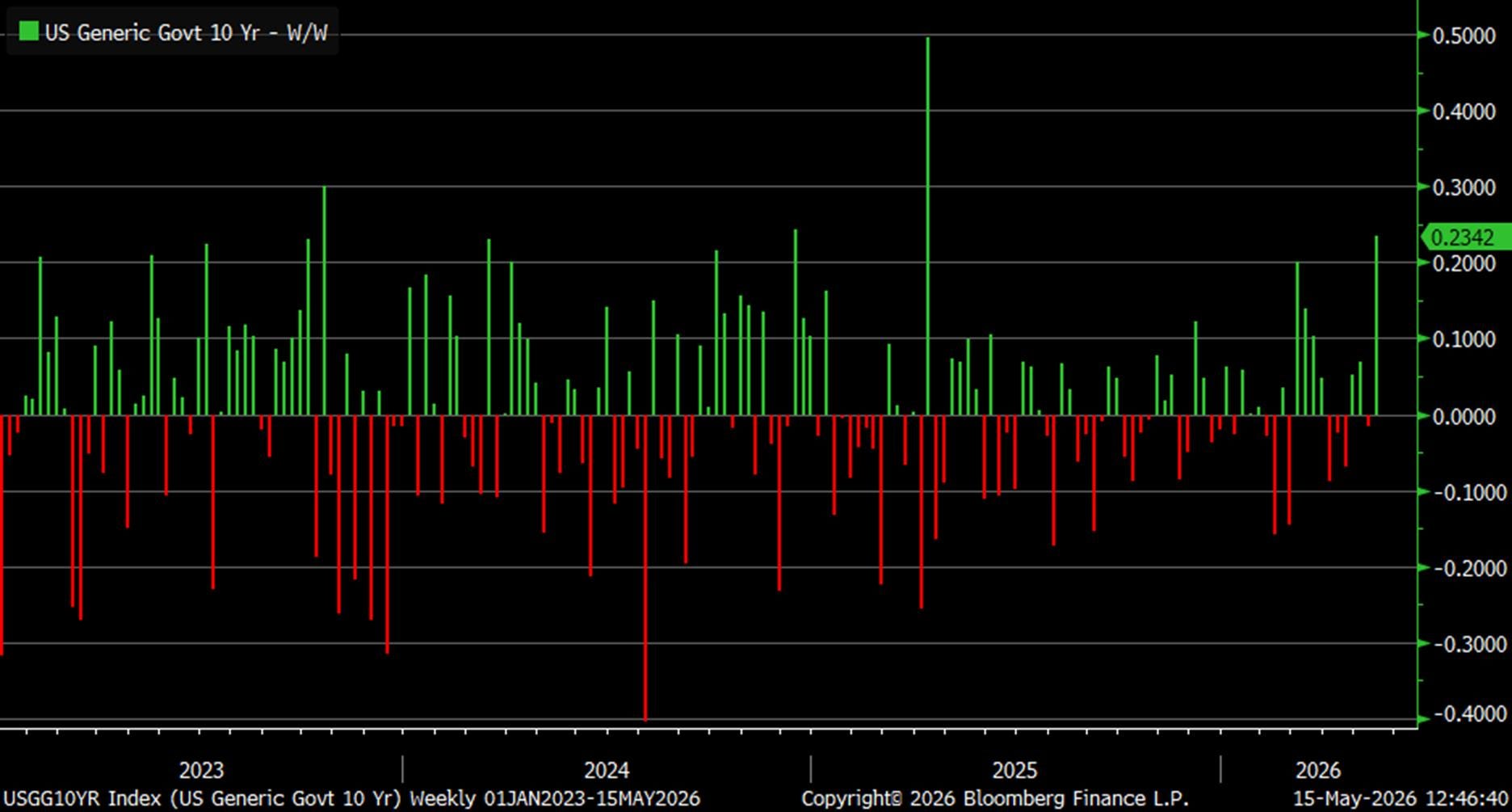
The yields on Treasuries are moving.
‘The 10y Treasury yield is currently seeing its largest weekly increase since April 2025’
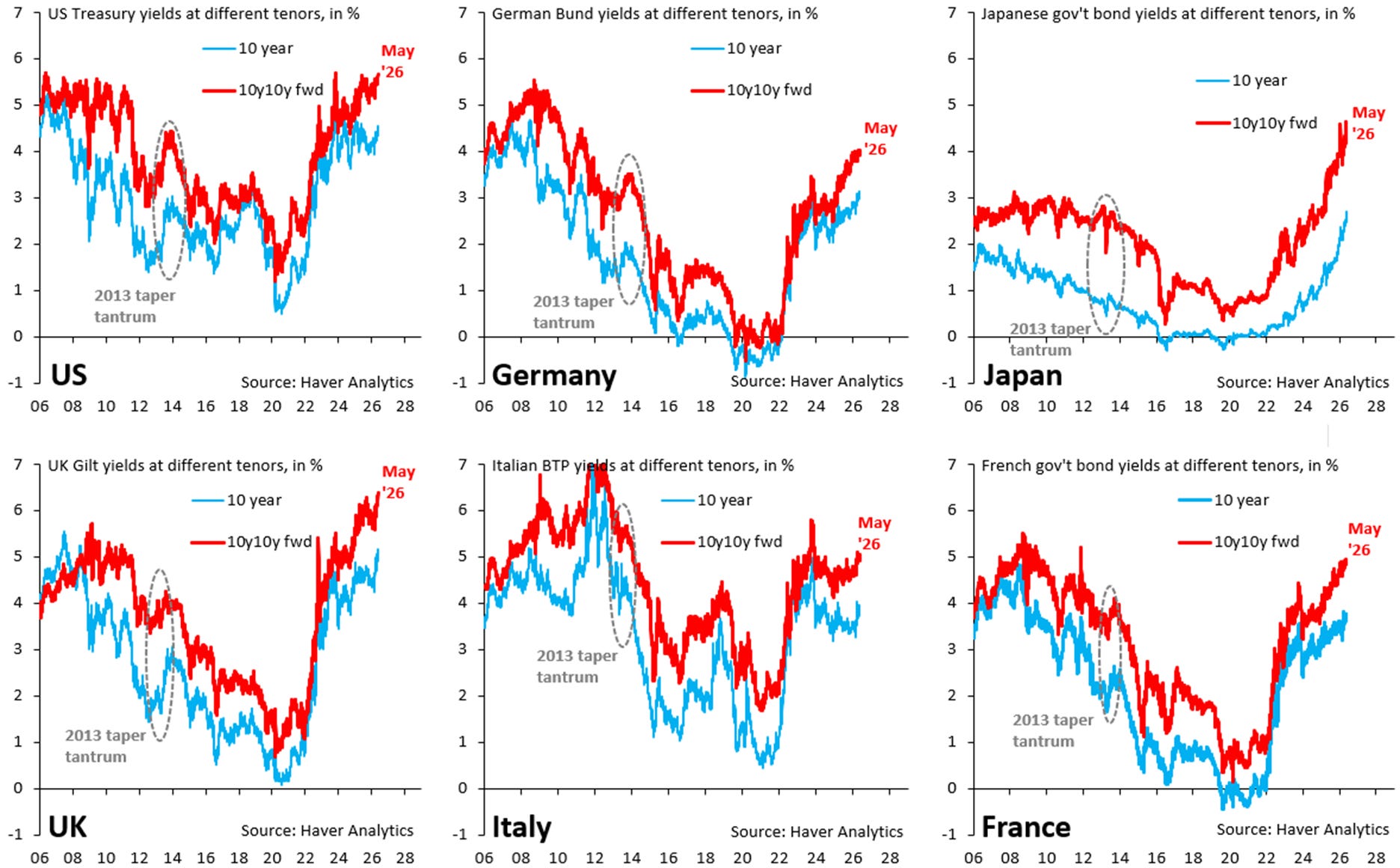
It’s a Developed Markets Debt Crisis
It’s not just the US.
‘It’s been my view for some time that we’re in a global debt crisis, with markets losing confidence that gov’ts will ever fix fiscal policy to bring down debt. Today’s a good reminder this is going on. 10y10y forward yield (red) at new highs in many places.
’
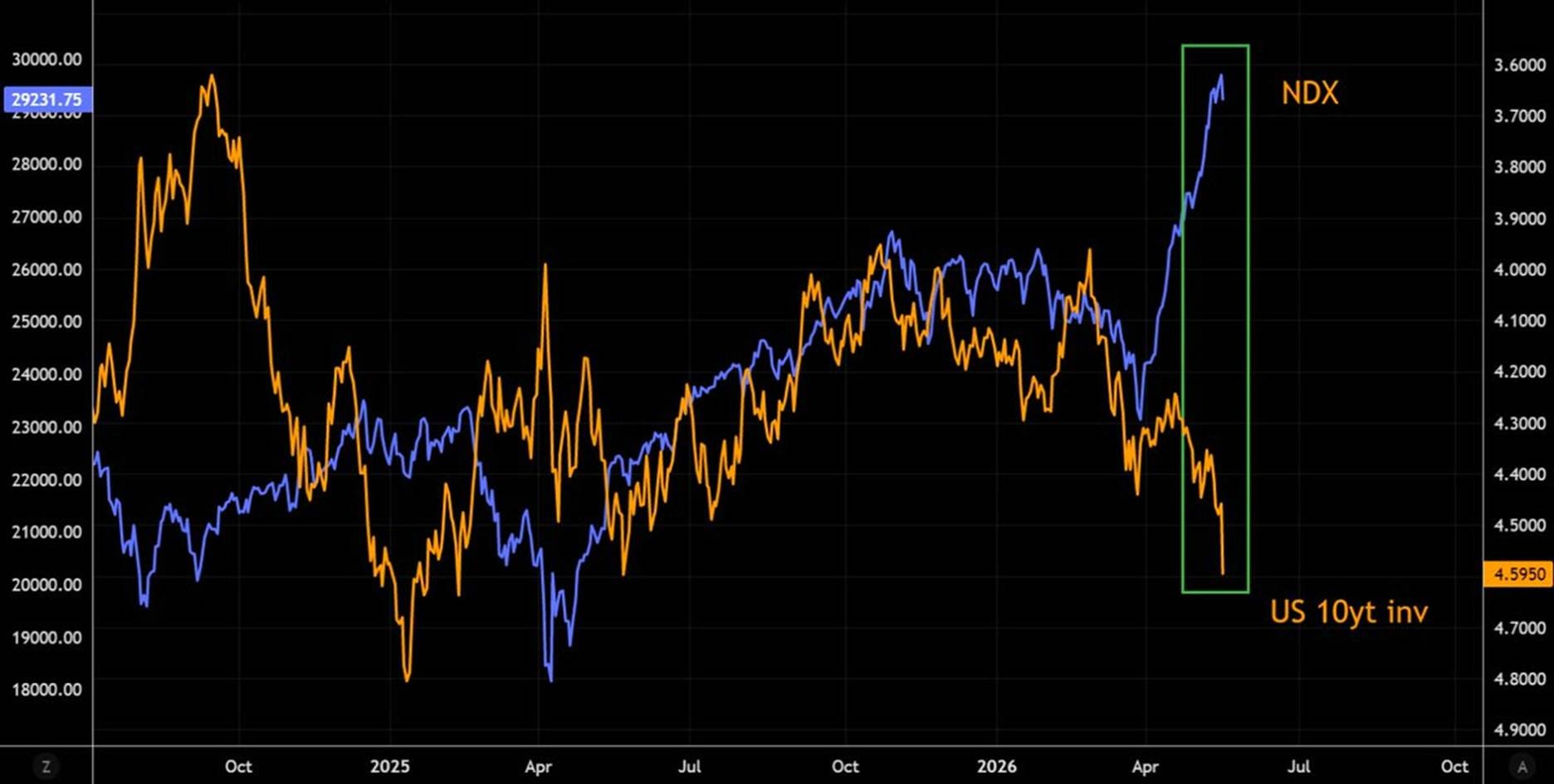
Bond Yields and Tech Equities Diverge
This divergence stands in sharp contrast to the one at the beginning of this chart.
‘Bond volatility is exploding higher just as hyperscalers enter the most capital-intensive spending cycle in modern tech history. Tech may have a rates problem again.’
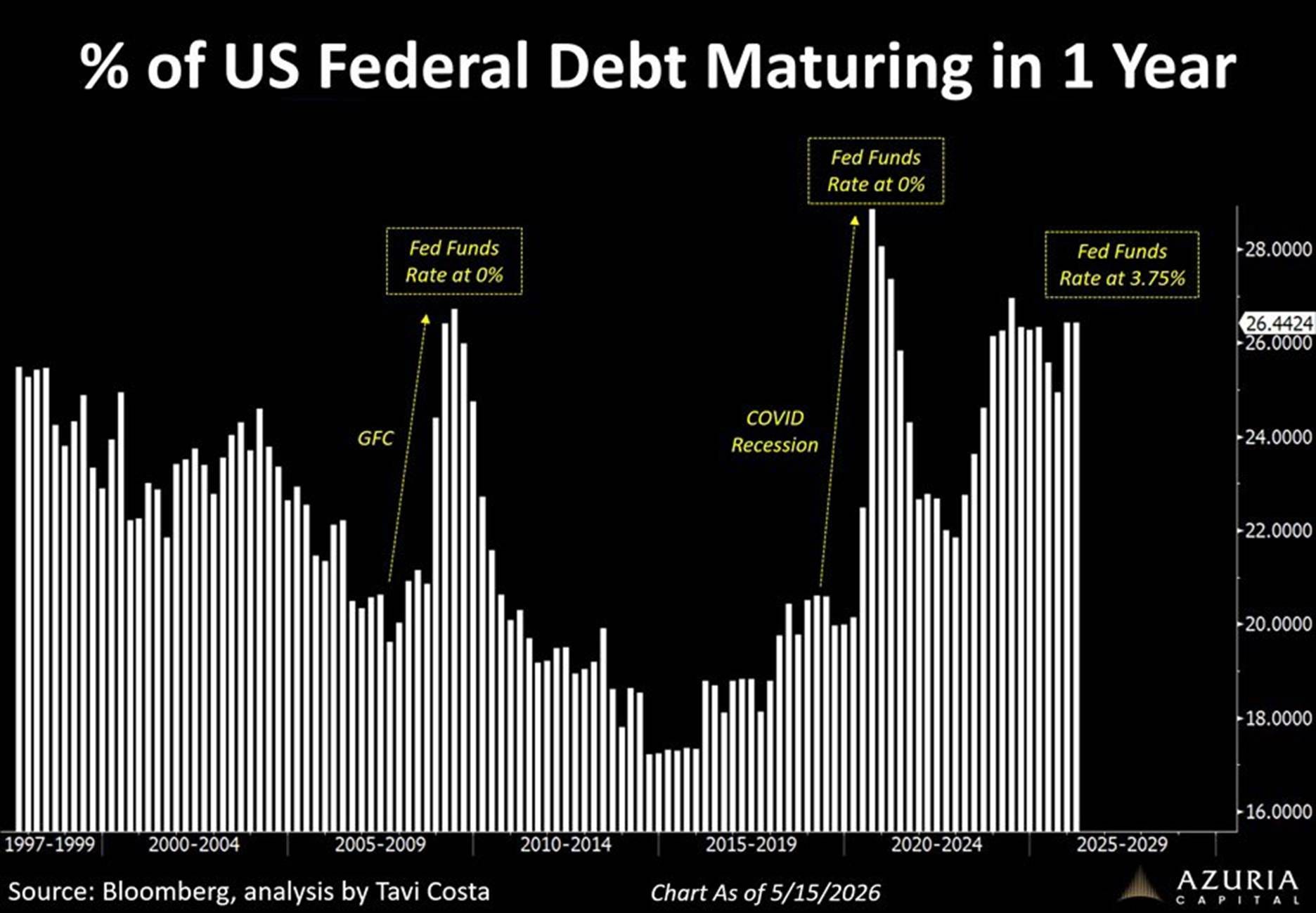
The maturity management of the US Treasury debt with rising rates is going to be an issue given the amount that rolls over in the next 12 months.
‘With yields surging recently: Here is a reminder that more than a quarter of all US federal debt will mature over the next 12 months. The clock is ticking, and this is likely to become a central focus for policymakers in the near term.

’
Bond Selloff Threatens to Knock AI Stock Frenzy Off Course
We’ve lived with high debt levels and seen equity indices move systematically higher through it all that we may be discounting the risk too much. It’s not complacency per se. It’s indifference.
‘What would it take to break this rally? Most investors interviewed pointed to the yield on 30-year Treasuries holding sustainably above 5% — the level where it’s already trading. Alexandre Drabowicz, chief investment officer at Indosuez Wealth Management, called that the “danger zone” for stocks.
‘Apprehension about yields is creeping higher as the impasse in the Strait of Hormuz persists, increasing the risk of elevated oil prices feeding into inflation and harming the economy. On Friday, a global rout in government bonds sent longer-dated Treasury yields to nearly their 2023 peak.
‘Long-term interest rates “sit at the crossroads of the cost of capital for AI capex and private credit,” said Kevin Thozet, from the investment committee at Carmignac. They affect the financing of government deficits and he noted their potentially “adverse impact” on consumer wealth.’
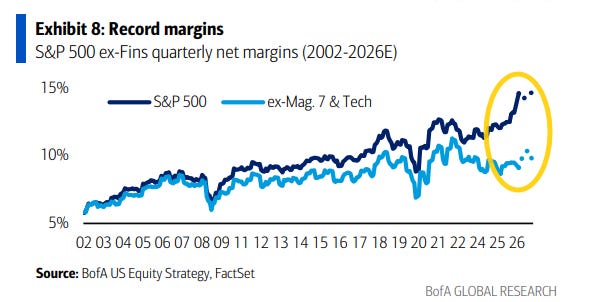
Margin Improvement Is Concentrated in Tech
‘BoA: The record profit margins are all a Mag-7 & Tech story.’
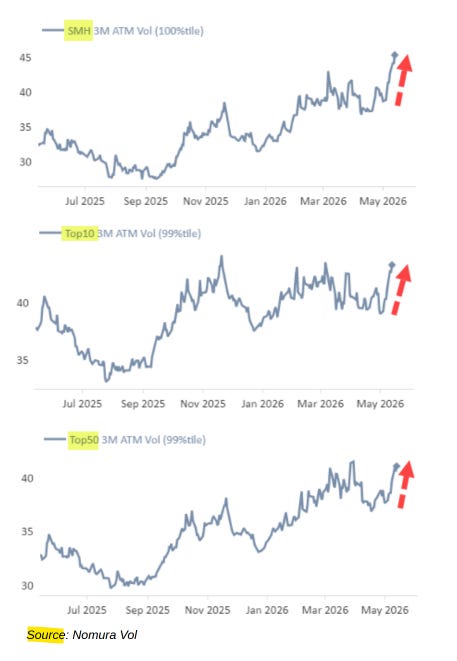
Spot Up, Vol Up Turns Ugly When It Turns
Index volatility may be presenting an artificially subdued picture.
‘Nomura’s McElligott notes that while there’s been relative calm on the VIX surface, the action underneath has been anything but with a warning that many others have mentioned that these sorts of things tend to collapse under their own weight: “Look at [semiconductor ETF] SMH [3-month at-the-money volatility which is] at 100%ile, Top 10 (largest mkt cap) [stocks at a] 3mth ATM Vol at 99%ile, and Top 50 3m ATM Vol at 99%ile….” “and you know what I say about ‘Spot Up, Vol Up’ tending to end when a trickle of profit-taking / monetization then turns sloppy and ‘Collapses Under the Weight of Its Own Delta’”.’
Spring Wheat Off to a Slow Planting Start
Everything, all at once.
‘Russia’s spring #wheat planting is off to its slowest start in years. Now May matters most. Cold and wet weather has delayed fieldwork. Some regions could soon run out of time, with Siberia the key area to watch in our view. Bloomberg: A break in the rain and improved weather conditions across the country’s main grain-producing regions could help speed up planting, said Sizov. “The first half of May is a make-or-break period,” Sizov said by phone. “If there was no acceleration in May, then there would be serious problems.” For now, Russia’s total wheat output is seen at 89.7 million tons, slightly higher than the previous season, according to SovEcon. The new crop forecast is due this week:
https://sizov.report/?utm_source=twitter&utm_medium=social&utm_campaign=May15_russia_planting
A Big Private Equity Bet on Chemicals Falters in Historic Slump
Oversupply from China combined with an energy crisis makes for a powerful combination, especially for Europe-based chemicals companies.
‘The chemicals industry experienced a “once-in-a-generation” downturn starting in the second half of 2022, said Timothy Riminton, a senior credit analyst at Bloomberg Intelligence. The war in the Middle East may help European companies win back an edge, but it comes too late for some of SK Capital’s holdings.’
The excesses China has built up will take some time to go away. And the Chinese government isn’t particularly interested in curing them, either.
‘This indeed is my biggest concern. If it takes 17 years for China’s industrial policy model to unwind and consumption share to rise as @michaelxpettis says it took with Japan, I wonder how much manufacturing capacity will be left in the rest of the world.’
Disclaimer: The content in this publication reflects my personal trading activities, market observations, and investment thought process. Nothing here constitutes investment advice, financial advice, trading advice, or any other sort of advice, and you should not treat any of this content as such. I am not a registered investment advisor or financial professional. All trading and investment decisions carry risk, including the potential loss of principal. You should conduct your own research, perform your own analysis, and consult with qualified financial professionals before making any investment decisions. Past performance does not guarantee future results. I may hold positions in securities discussed.